She was meant for the 1876 centennial. She arrived ten years later, and the pedestal almost went unfunded.
The idea: a gift from France
The name at the start of the story is Édouard de Laboulaye, a jurist, historian, and anti-slavery activist. According to the U.S. National Park Service, the idea of a monument given by the French people to the United States is usually traced to a 1865 conversation with the sculptor Frédéric Auguste Bartholdi. A later report from the same agency, however, calls that scene a legend and suggests the statue was more likely conceived around 1870.
What is clear is the spirit of the project: to mark the centennial of American independence, celebrate the end of slavery after the Civil War, and honor the friendship between the two countries. For Laboulaye it was also a way of pointing to the liberty France lacked under the regime of Napoleon III.
It helps to separate legend from fact: the after-dinner scene in which Laboulaye supposedly made the proposal is commonly retold, but the official source itself invites caution. What is not disputed is that the two men knew each other, shared political ideas, and saw in the statue a way to bring two republics together.
Bartholdi: from an Egyptian lighthouse to New York Harbor
Bartholdi had already dreamed big. In the late 1860s he proposed to Egypt's ruler a colossal lighthouse shaped like a robed woman holding a torch, at the entrance to the Suez Canal. Sketches and models were made, but the project was turned down, according to the sources because of its cost. Several historians see it as a clear forerunner of the statue.
After the Franco-Prussian War, Bartholdi crossed the Atlantic in June 1871 with letters of introduction from Laboulaye. Sailing into New York Harbor, he fixed on Bedloe's Island, today's Liberty Island, because every ship arriving had to pass by it. That year he met President Ulysses S. Grant, who assured him that getting the site would not be difficult.
Bartholdi also worked on monuments meant to restore French pride after the defeat by Prussia, such as the Lion of Belfort. That mix of patriotism and Romantic feeling, the sources say, is what he later brought to the New York statue.
Who paid for what: France the statue, America the pedestal
The split was clear: France would fund and build the statue, and the United States would provide the site and build the pedestal. To raise the money, the Franco-American Union was founded in 1874. French funds came from donations by cities, institutions, and individuals, and from banquets, shows, and lotteries. One source mentions around a hundred thousand donors and a budget that rose past a million francs, and the full amount was not gathered until 1880.
On the American side of the ocean, fundraising was hard. There were theater performances, art exhibitions, auctions, and even boxing matches. To see what the pedestal and museum offer today, read Statue of Liberty pedestal and museum.
If you want to picture the scale of the effort, imagine the fundraising as a long relay: committees in French towns on one side, newspaper readers and event audiences in the United States on the other, and a pedestal waiting in the middle of a harbor island.
An iron skeleton and a copper skin
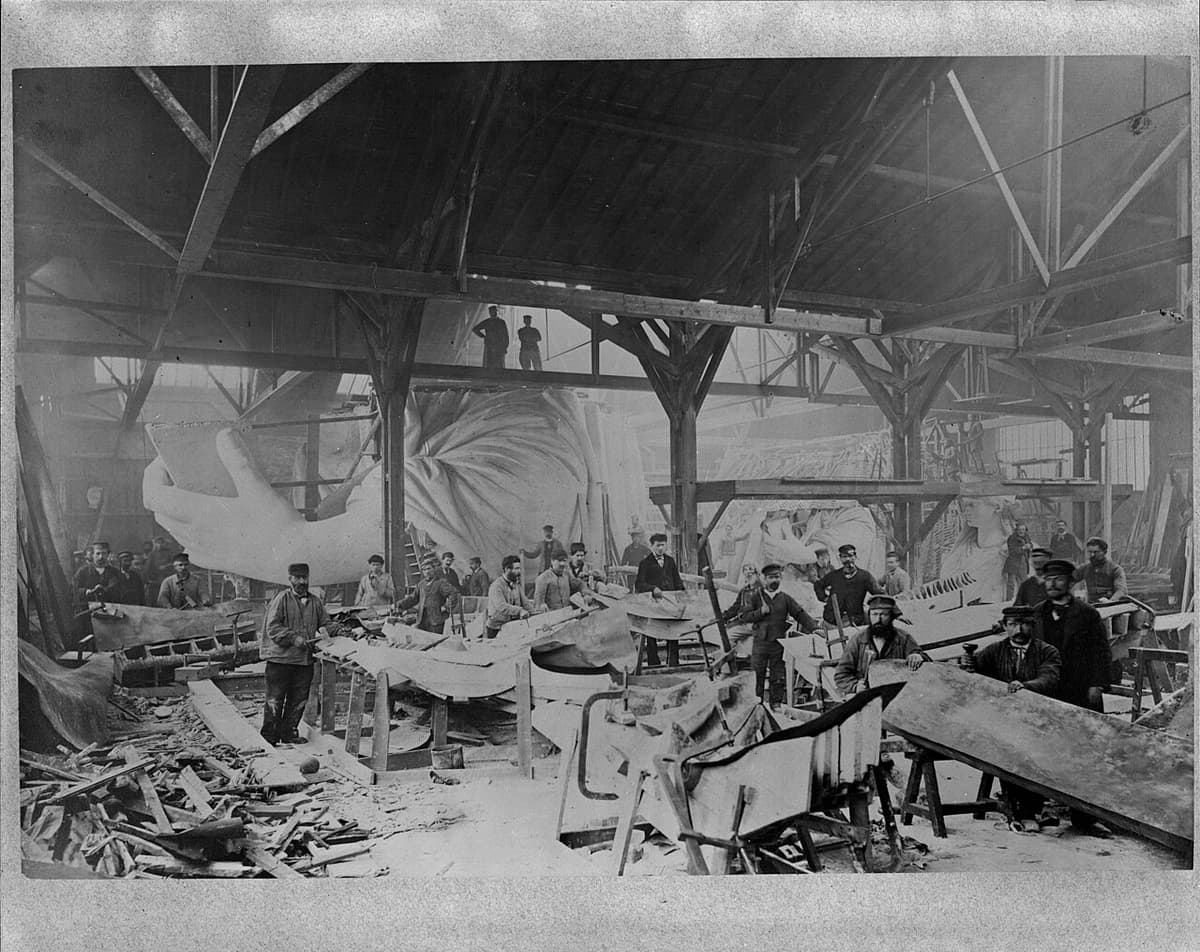
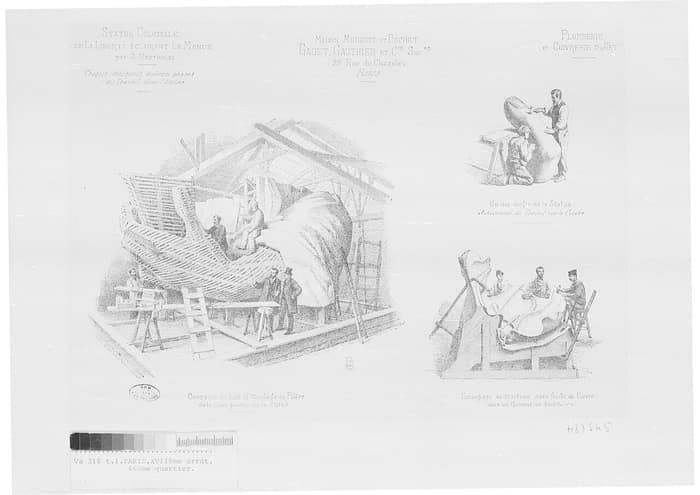
Bartholdi chose copper over bronze or stone because it was cheaper, lighter, and easier to ship. A thin skin like that needs a structure inside, and for it he turned to the engineer Gustave Eiffel, the same man who would later put his name on the Paris tower. Eiffel devised an inner tower and a secondary framework that kept the copper covering upright.
Before the figure was finished, the head and the torch-bearing arm were already on show as publicity. That piece has its own page: The original torch of the Statue of Liberty. The statue was assembled in Paris, and on July 4, 1880 it was formally handed over to the American minister there, at a banquet.
A practical note for the traveler: what you see today as a green skin is that same copper covering, which looked different in 1886. The inner structure is also why the monument has been repaired and restored several times without losing its shape.
Pulitzer and the pedestal drive
The statue was nearly ready, but the pedestal was stalling for lack of money. That was when publisher Joseph Pulitzer, through his newspaper the New York World, launched a donation drive to finish the job. The sources we consulted point to it as a key moment in getting the project completed.
This campaign is often linked to Emma Lazarus's poem «The New Colossus», written to help raise funds and later tied to the idea of welcoming immigrants. Its connection to the statue deepened over time, which is why many visitors think of it as they step onto the island.
Crates, sea, and assembly on the island
The statue was built in France and shipped across the ocean taken apart, in crates. In New York it was assembled on the finished pedestal on what was then called Bedloe's Island. The work had to be done piece by piece, and the result was a figure about 46 meters tall (the top of the torch reaches roughly 93 meters above mean low water, according to one source), resting on a pedestal built to carry it.
To understand what a visit looks like today, and how reaching the island differs from climbing the pedestal or the crown, see How to visit the Statue of Liberty.
When you are on the island, remember that every element had to cross the sea, wait its turn, and fit into place. That idea of a traveling monument makes the visit more than a photo: you are standing in front of a work that crossed the Atlantic in pieces.
The 1886 dedication and what came after
The statue was dedicated on October 28, 1886, in a ceremony presided over by President Grover Cleveland. Its completion was celebrated with New York's first ticker-tape parade. A full decade had passed since the centennial it had been meant for.
Over the years, management changed hands. The statue was under the Lighthouse Board until 1901, then the War Department, and since 1933 the National Park Service has looked after it. It was declared a national monument in 1924, and UNESCO has listed it as a World Heritage Site since 1984. Across the bay, the neighboring island tells another chapter of the same story: Ellis Island: what to see.
Tours to learn the history of the Statue of Liberty
A guided visit can help put what you see in context: the island, the pedestal, and, if it is included, Ellis Island. Compare the length, whether you land on the island, and what each tour covers before booking.

Statue of Liberty & Ellis Island Tour with Reserved Ferry Entry
Check availability
Statue of Liberty and Ellis Island Guided Tour with Ferry
Check availability
NYC City Tour: Statue of Liberty, 9/11 Memorial, Wall Street
Check availability
Private Statue of Liberty and Ellis Island Tour
Check availability
Statue of Liberty and New York City Skyline Sightseeing Cruise
Check availability
Statue of Liberty & NYC Skyline Cruise - Freedom Liberty Tour
Check availabilityTour titles and descriptions appear as on the booking platform. No tour guarantees a ticket or a specific experience.
See more tours and activities on GetYourGuide →Frequently asked questions
Who gave the Statue of Liberty to the United States?
It was a gift from the people of France. France funded and built the statue, and the United States provided the site and built the pedestal. The idea is credited to Édouard de Laboulaye, and the design to the sculptor Frédéric Auguste Bartholdi.
Who designed the Statue of Liberty?
French sculptor Frédéric Auguste Bartholdi designed the figure. The iron framework supporting the copper skin was engineered by Gustave Eiffel. The pedestal was built in New York with funds raised in the United States.
When was the Statue of Liberty dedicated?
It was dedicated on October 28, 1886, in a ceremony presided over by President Grover Cleveland. It had been intended for the 1876 centennial of American independence, but was delayed by about ten years because of war, costs, and lack of funds.
How did the statue get to New York?
It was built in France, taken apart, and shipped across the Atlantic in crates. On Bedloe's Island, now Liberty Island, it was assembled piece by piece on the pedestal, which was already finished.
Why was Liberty Island chosen?
Bartholdi noticed Bedloe's Island because every ship entering New York Harbor passed by it. It was also owned by the U.S. government, which made securing the site simpler.
How was the pedestal paid for?
Fundraising in the United States was difficult. Publisher Joseph Pulitzer, through the New York World, launched a donation drive that helped finish it. Earlier, performances, auctions, and other events had raised funds.
Who runs the statue today?
Since 1933 it has been maintained by the U.S. National Park Service as part of the Statue of Liberty National Monument. Before that it was under the Lighthouse Board and the War Department.
Keep reading

New York helicopter tour over the Statue of Liberty
From the air, the torch sits below eye level and the whole city looks like a scale model.

Statue of Liberty frequently asked questions
One part of the Statue has been closed to the public for over a century, and it is not the crown.

Statue of Liberty pedestal and museum
Under the statue lies a star-shaped fort that hardly anyone notices.

Statue of Liberty with kids: a family guide
To a child the statue is a green giant; the trick is how you tell her story.
Sources
Facts taken from Wikipedia and the U.S. National Park Service (public domain). Always verify practical information on the official websites.
Photo credits
- Fernique, Albert, 1841?-1898, photographer, Wikimedia Commons, Public domain
- Elekes Andor, Wikimedia Commons, CC BY-SA 4.0
- Wikimedia Commons, Wikimedia Commons, Public domain